
The Heat Exchanger Rating and Selection Tool is professional engineering software developed by WeBBusterZ Engineering Software for evaluating the thermal and hydraulic performance of heat exchangers under specified operating conditions.
Designed for engineers involved in equipment evaluation, process engineering and heat-transfer applications, this heat exchanger rating software provides a structured approach to calculating heat duty, assessing heat-transfer performance and evaluating pressure losses through different heat exchanger configurations.
The application supports Shell-and-Tube, Gasketed Plate and Helical Coil heat exchangers, offering engineering calculation methods appropriate to each supported configuration.
Thermal and Hydraulic Performance Evaluation
Engineers can use the software to assess existing heat exchangers, investigate changes in operating conditions and determine whether equipment is capable of meeting specified thermal requirements.
Depending on the exchanger type and selected calculation method, the application can evaluate heat-transfer coefficients, temperature differences, available heat-transfer area, fluid-flow characteristics and applicable pressure drops.
In addition to Rating, the software includes an integrated Heat Exchanger Selection module, allowing engineers to evaluate and compare suitable equipment from their own customisable equipment catalogue.
The application also provides fluid property calculations, engineering project management, Company Workspace collaboration and reporting capabilities.
By combining thermal rating, hydraulic calculations and equipment selection within a single Windows desktop application, the Heat Exchanger Rating and Selection Tool helps engineers assess equipment performance and make informed engineering decisions.
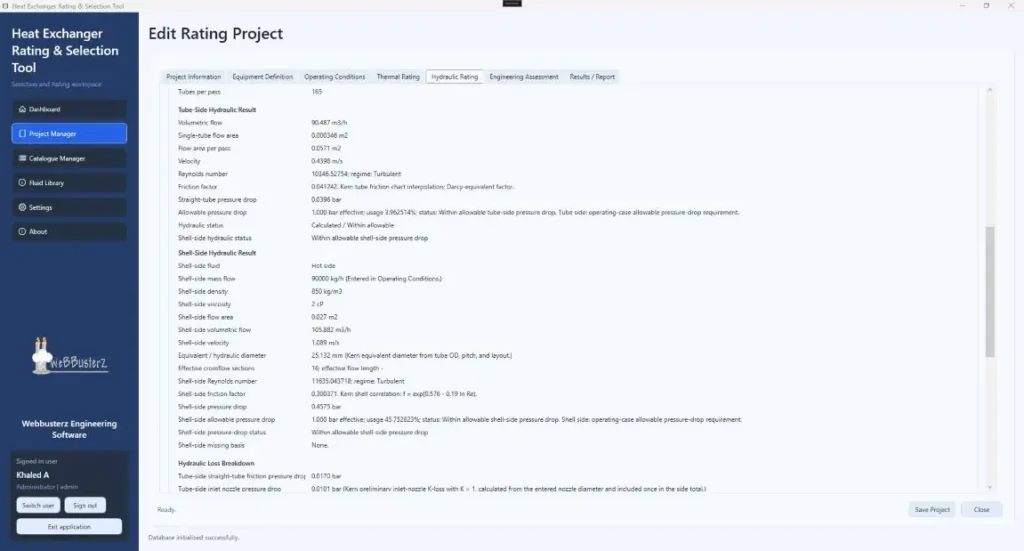
Heat Exchanger Thermal Rating and Heat Transfer Calculations
Evaluating the thermal performance of an existing heat exchanger is essential when determining whether it can meet specified process requirements. Changes in flow rates, inlet temperatures, fluid properties or fouling conditions can significantly affect heat-transfer performance.
The Heat Exchanger Rating and Selection Tool provides engineering calculation methods to assess the performance of supported heat exchanger configurations under specified operating conditions.
Heat Duty and Energy Balance
The software enables engineers to evaluate the thermal duty associated with heating and cooling processes.
Depending on the selected calculation method and available process information, calculations can include:
- Heat Duty: Determine the rate of heat transfer between hot and cold process streams.
- Energy Balance: Evaluate thermal energy transferred between the two streams.
- Operating Temperatures: Assess inlet and outlet temperatures under specified conditions.
- Fluid Flow Rates: Account for mass flow rates and fluid properties when evaluating heat-transfer requirements.
- Sensible and Latent Heat: Evaluate applicable heating, cooling and supported phase-change conditions.
These calculations help engineers assess whether the specified exchanger can achieve the required heating or cooling duty.
Overall Heat Transfer Coefficient
The overall heat-transfer coefficient is an important parameter when evaluating exchanger thermal performance.
The software supports applicable methods for calculating or specifying heat-transfer coefficients based on the exchanger configuration, available geometry and fluid operating conditions.
Depending on the selected method, the thermal evaluation can account for:
- Hot-side and cold-side heat-transfer coefficients.
- Fluid properties and flow characteristics.
- Heat-transfer surface geometry.
- Thermal resistance of the separating wall.
- Specified fouling resistances.
These factors influence the exchanger’s overall heat-transfer performance and its ability to meet the required thermal duty.
LMTD and Effectiveness-NTU Analysis
The application supports established thermal analysis approaches for applicable heat exchanger configurations.
Log Mean Temperature Difference (LMTD) calculations evaluate the effective temperature driving force between the hot and cold process streams.
Effectiveness-NTU methods provide an alternative approach for assessing exchanger thermal performance using applicable heat-capacity rates and heat-transfer characteristics.
The available methods depend on the heat exchanger type, flow arrangement and supported calculation conditions.
Heat Transfer Area and Thermal Adequacy
The software helps engineers compare the thermal requirements of a process with the capabilities of the specified equipment.
Calculations can include:
- Required heat-transfer surface area.
- Available exchanger heat-transfer area.
- Thermal performance under specified operating conditions.
- Assessment of exchanger suitability for the required duty.
- Identification of operating conditions that may require further engineering review.
This allows engineers to investigate how changes in flow rates, temperatures or thermal performance parameters affect equipment suitability.
Applications of Heat Exchanger Rating Software
Thermal rating calculations can assist engineers when:
- Evaluating the performance of an existing heat exchanger.
- Assessing equipment under revised process conditions.
- Reviewing heat-transfer limitations.
- Investigating the effect of fouling allowances.
- Comparing exchanger performance across different operating scenarios.
- Checking whether equipment has adequate thermal capacity for a specified application.
By providing structured thermal calculations and performance assessments, the Heat Exchanger Rating Software helps engineers evaluate heat exchanger operating conditions and support informed equipment decisions.
Heat Exchanger Hydraulic Analysis and Pressure Drop Calculations
Hydraulic performance is an important consideration when evaluating heat exchangers. Excessive pressure losses can affect pumping requirements, operating costs and the suitability of equipment for a particular application.
The Heat Exchanger Rating and Selection Tool incorporates hydraulic calculation methods to help engineers assess fluid-flow behaviour and pressure drops across supported heat exchanger configurations.
Fluid Flow and Hydraulic Performance
The software evaluates relevant flow characteristics based on the specified operating conditions, fluid properties and available exchanger geometry.
Depending on the exchanger type and selected calculation method, hydraulic results can include:
- Fluid Velocity: Evaluation of flow velocities through applicable exchanger passages.
- Reynolds Number: Assessment of fluid-flow conditions using relevant properties and characteristic dimensions.
- Hydraulic Diameter: Calculation or application of appropriate equivalent flow dimensions.
- Friction Factor: Evaluation using supported engineering correlations.
- Pressure Drop: Estimation of pressure losses across applicable exchanger flow paths.
- Hydraulic Operating Conditions: Assessment of calculated pressure losses against specified operating requirements.
These calculations help engineers identify potential hydraulic limitations when evaluating existing equipment.
Hydraulic Calculations for Different Heat Exchanger Types
The application provides hydraulic evaluation methods appropriate to the supported exchanger configurations.
Shell-and-Tube Heat Exchangers
Evaluate tube-side and shell-side fluid-flow characteristics and pressure losses using applicable calculation methods and equipment geometry.
Gasketed Plate Heat Exchangers
Assess fluid velocities and pressure losses through supported plate-channel arrangements using the selected hydraulic calculation methods.
Helical Coil Heat Exchangers
Evaluate pressure losses and flow characteristics for supported helical-coil configurations, including applicable coil-side and surrounding-fluid flow arrangements.
The available methods and results depend on the exchanger configuration, flow arrangement and supplied geometry.
Engineering Correlations and Calculation Methods
The software incorporates engineering correlations for estimating fluid-flow resistance and hydraulic performance.
Depending on the selected heat exchanger type, calculations can account for parameters such as Reynolds number, friction factor, characteristic dimensions and flow-path geometry.
Applicable calculation methods are used within their supported conditions and limitations.
Pressure Drop and Equipment Suitability
Hydraulic calculations can help engineers:
- Evaluate whether pressure losses are acceptable for the intended operating conditions.
- Review pumping and fluid-circulation requirements.
- Investigate the effect of changing fluid-flow rates.
- Compare hydraulic performance under alternative operating scenarios.
- Assess equipment suitability alongside thermal performance.
Combining Thermal and Hydraulic Rating
An exchanger may provide sufficient heat-transfer capacity while producing an unacceptable pressure drop. For this reason, both thermal and hydraulic performance should be considered when evaluating equipment.
By combining heat exchanger pressure drop calculations with thermal performance analysis, the Heat Exchanger Rating Software helps engineers assess operating suitability using a consistent engineering workflow.
The calculated results provide engineering estimates based on the selected methods and input data. Final equipment suitability should be verified against applicable design requirements and manufacturer specifications.
Supported Heat Exchanger Types and Equipment Selection
The Heat Exchanger Rating and Selection Tool provides thermal and hydraulic evaluation capabilities for three major categories of heat exchangers: Shell-and-Tube, Gasketed Plate and Helical Coil.
Each exchanger configuration has different thermal characteristics, flow arrangements and hydraulic considerations. The software applies supported engineering calculation methods appropriate to the selected exchanger type.
Supported Heat Exchanger Configurations
| Heat Exchanger Type | Rating Capabilities |
|---|---|
| Shell-and-Tube Heat Exchangers | Thermal performance evaluation, heat-transfer coefficients, tube-side and shell-side calculations, and applicable pressure-drop assessments. |
| Gasketed Plate Heat Exchangers | Heat-duty calculations, thermal performance evaluation, heat-transfer area assessment and supported plate-channel hydraulic calculations. |
| Helical Coil Heat Exchangers | Thermal and hydraulic evaluation of supported coil configurations, including applicable coil-side and surrounding-fluid calculations. |
The availability of individual calculations depends on the selected equipment geometry, operating conditions and applicable engineering correlations.
Integrated Heat Exchanger Selection
In addition to evaluating existing equipment, the software includes a Heat Exchanger Selection module.
This enables engineers to identify and compare suitable heat exchangers from a user-maintained equipment catalogue.
The selection process considers relevant operating requirements and available equipment specifications, helping engineers narrow down potential candidates.
Key selection capabilities include:
- Equipment Screening: Evaluate catalogue models against specified operating conditions and applicable equipment limitations.
- Thermal Suitability: Assess heat-transfer requirements and available equipment characteristics.
- Candidate Comparison: Compare relevant specifications and calculated performance parameters.
- Selection Ranking: Organise suitable equipment according to the application’s supported selection criteria.
- Operating Limit Checks: Identify equipment that does not satisfy applicable operating restrictions.
Customisable Heat Exchanger Equipment Catalogue
The application allows engineers to create and maintain their own heat exchanger equipment catalogue.
Users can record relevant equipment information, including manufacturer references, model specifications, geometry, materials and operating limits.
The catalogue can contain records of existing equipment, proposed heat exchangers or models supplied by different manufacturers.
Important: The software does not include a comprehensive commercial supplier catalogue or automatically retrieve heat exchanger specifications from manufacturers. Users maintain the equipment data used for selection.
Rating and Selection in One Application
Combining thermal and hydraulic rating with equipment selection allows engineers to evaluate existing heat exchangers and compare potential alternatives within the same software.
Whether investigating changes in operating conditions or assessing equipment for a new process requirement, the Heat Exchanger Rating Software provides engineering tools to support performance evaluation and equipment selection decisions.
Fluid Properties, Project Management and Engineering Reporting
The Heat Exchanger Rating and Selection Tool combines engineering calculations with fluid property evaluation, project management and reporting capabilities. These integrated features help engineers perform heat exchanger assessments, organise calculation data and maintain records of equipment performance.
Fluid Property Calculations
Accurate thermophysical properties are essential for evaluating heat-transfer performance and fluid-flow behaviour.
The software provides several methods for obtaining and managing fluid property information, including:
- CoolProp Integration: Calculate thermophysical properties for supported fluids at specified operating conditions.
- Water and Steam Properties: Evaluate applicable water and steam properties using IAPWS-IF97 formulations.
- User-Defined Fluid Properties: Enter fluid properties manually when required.
- Fluid Property Database: Maintain stored fluid information for use in thermal and hydraulic calculations.
Depending on the selected fluid and calculation method, relevant properties include density, specific heat capacity, viscosity and thermal conductivity.
Engineering Project Management
The application includes an integrated Project Manager for organising heat exchanger rating and selection studies.
Engineers can:
- Create, save and reopen engineering projects.
- Duplicate projects to investigate alternative operating conditions.
- Archive completed or inactive projects.
- Maintain equipment information and calculation results for future reference.
- Manage project access using supported user permissions.
These capabilities help users maintain organised records of equipment evaluations and thermal performance studies.
Company Workspace Collaboration
The software also provides Company Workspace functionality for organisations requiring shared access to engineering projects.
Authorised users can work with projects stored in a configured shared location, subject to the application’s access controls.
This enables engineering teams to maintain shared project information while using individually licensed installations of the software.
Company Workspace does not require a Network Licence. Network licensing is a separate option for organisations that need a shared pool of concurrent software licences.
Engineering Results and Reports
The software presents thermal and hydraulic results in a structured format, allowing engineers to review calculated performance parameters and equipment suitability.
Depending on the analysis performed, results can include:
- Heat duty and thermal performance.
- Overall heat-transfer coefficients.
- Required and available heat-transfer areas.
- Operating temperatures and temperature differences.
- Fluid-flow characteristics and pressure drops.
- Equipment suitability assessments.
- Selection results and candidate comparisons.
Reporting and export capabilities allow relevant engineering results to be documented and retained for future reference.
Engineering Units and Demonstration Examples
The application supports SI, US customary and configurable engineering units, allowing engineers to work with familiar measurement systems.
It also includes eight predefined demonstration projects, covering Rating and Selection examples, to help users explore the software’s calculation methods and interface.
An Integrated Heat Exchanger Engineering Application
By combining fluid properties, thermal and hydraulic rating, equipment selection and project management, the Heat Exchanger Rating Software provides a practical environment for evaluating existing equipment and investigating alternative operating conditions.
These capabilities support engineers involved in process design, equipment evaluation, maintenance and heat-transfer applications.
Heat Exchanger Rating Software Screenshots
Explore the interface and engineering capabilities of the Heat Exchanger Rating and Selection Tool through our software screenshots.
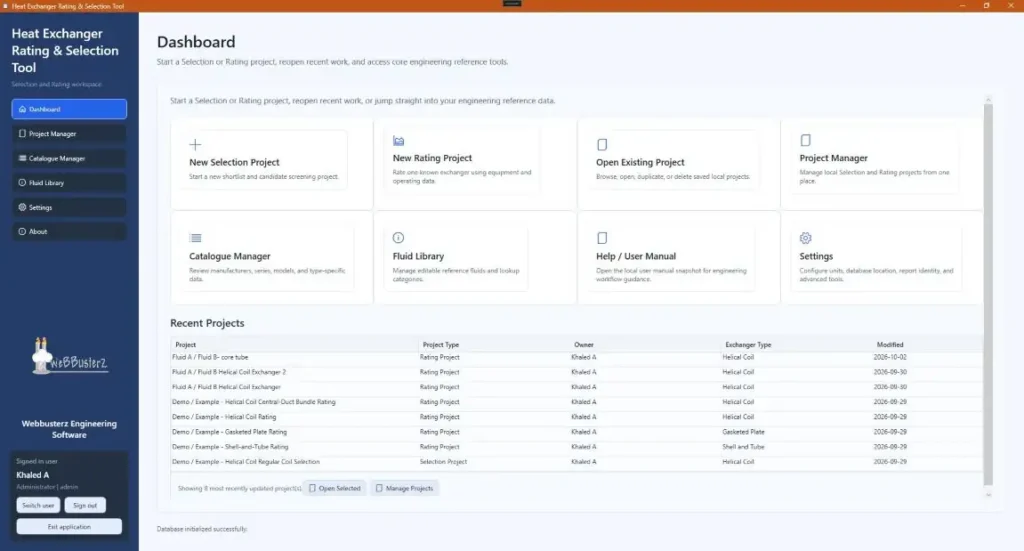
View examples of thermal and hydraulic calculations, heat exchanger selection, equipment catalogue management and engineering results.
View Software Screenshots – Access additional screenshots through our Flickr and Facebook galleries.
System Requirements
The Heat Exchanger Rating and Selection Tool is a self-contained Windows desktop application designed for 64-bit computers.
| Component | Requirements |
|---|---|
| Operating System | Windows 10 or Windows 11 (64-bit) |
| Processor | 64-bit Intel or AMD processor |
| Memory | 4 GB RAM minimum; 8 GB recommended |
| Disk Space | 500 MB available; 1 GB recommended |
| Display Resolution | 1366 × 768 minimum; 1920 × 1080 recommended |
| Internet Connection | Required for applicable licence activation, validation and software updates |
| .NET Runtime | Included with the application |
| Database | Integrated SQLite database |
The software includes eight predefined demonstration projects to help users become familiar with its engineering capabilities.
Company Workspace collaboration requires access to an appropriately configured shared storage location.
Download Heat Exchanger Rating Software Demo
Evaluate the Heat Exchanger Rating and Selection Tool before purchasing a licence.
Download the demonstration version to explore the software interface, supported heat exchanger configurations and available thermal and hydraulic calculation features.
Download Demo Version
See the Version History
Heat Exchanger Rating Software — Video Demonstration
A video demonstration of the Heat Exchanger Rating and Selection Tool is currently being prepared.
The upcoming video will introduce the software’s main features, including thermal and hydraulic rating, equipment selection and engineering project management.
Video Demonstration — Coming Soon
Software Licensing and Purchase Options
The Heat Exchanger Rating and Selection Tool is available with licensing options for individual engineers and organisations.
| Licence Type | Description | Purchase |
|---|---|---|
| Single-User Perpetual Licence | One-time purchase providing ongoing use of the licensed software, subject to the licence terms. | Buy Now |
| Single-User 1-Year Licence | Full software functionality for 12 months with a one-time payment and no automatic renewal. | Buy Now |
| Network Licence | Concurrent-user licensing for organisations requiring shared access to software licences across multiple computers. | Contact Us |
Volume discounts are available for eligible multiple-licence purchases.
Visit our Buy Now page for current prices, volume discounts and secure online purchasing.